
Custom Jewelry Manufacturing Lead Times, Converted to Days
Lead times are usually quoted in the unit that flatters them. Weeks sound shorter than days, and days sound shorter than hours. Converted to a single unit, the published figures are: 48 hours for CAD, 25–30 days for a master sample, 21–28 days for bulk production, and 48–60 days for the route end to end. That total is 1,152 to 1,440 hours, and the number that matters is how many of them fall on a weekend.

Key takeaways
- 48 hours is 2 calendar days; 25–30 days is 3.6–4.3 weeks; 21–28 days is 3–4 weeks.
- The full pre-production route is 48–60 days, or 1,152–1,440 hours, before freight.
- CAD accounts for 48 ÷ 1,440 = 3.3% of the longest total, so it is never the constraint.
- Approval latency sits outside every published window and is the only variable a buyer fully controls.
Why the unit matters more than the number
"Four weeks" and "28 days" are the same duration written two ways, but they produce different plans. A buyer who hears four weeks blocks four rows of a calendar and assumes 20 working days. A buyer who hears 28 days blocks 28 rows and assumes 20 working days plus two weekends. Only the second buyer notices that a sample signed on a Friday afternoon cannot be packed and shipped until the following Monday at the earliest.
Hours behave differently again. A 48-hour promise can mean two working days or can mean a literal 48-hour clock that runs through a weekend. The distinction is harmless for CAD, which is a desk task, and expensive for anything touching a bench, where a stopped line does not restart itself.
The conversion worth memorising is one week to seven days, and one working week to five. Published figures use calendar days, which is the honest unit for a production schedule because it includes the days when nothing ships. A buyer who converts to working days before comparing quotes will find that two apparently different lead times are often the same plan described in different units.
The three clocks, converted
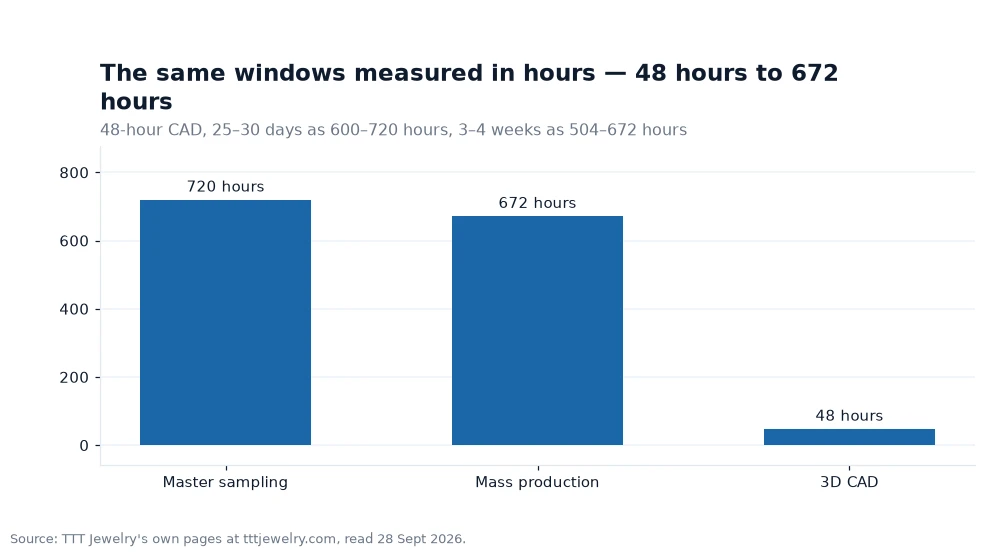
CAD modelling is published at under 48 hours. Converted: 2 days, 0.3 of a week, or 48 hours of elapsed time. As a share of the 25–30 day sampling window, it is 48 ÷ 600 = 8% at the short end and 48 ÷ 720 = 6.7% at the long end. As a share of the entire 1,152–1,440 hour route, it is 48 ÷ 1,440 = 3.3% at the long end and 48 ÷ 1,152 = 4.2% at the short end.
Master sampling is published at 25–30 days. That is 3.6 to 4.3 weeks, or 600 to 720 hours. This is the longest single window and the one with the most interior variability, because it contains mould work, casting, setting, polishing and plating. A sample that arrives on day 25 has had the same sequence as one that arrives on day 30; the difference is queue position, not process.
Bulk production is published at 3–4 weeks, which is 21–28 days, or 504 to 672 hours. It is shorter than sampling because the decisions are already made. Nothing in bulk requires a new mould or a new plating trial, so the work is repetition with inspection attached.
| Stage | Published window | Calendar days | Hours |
|---|---|---|---|
| 3D CAD modelling | Under 48 hours | 2 | 48 |
| Master sampling | 25–30 days | 25–30 | 600–720 |
| Bulk production | 3–4 weeks | 21–28 | 504–672 |
| Pre-production total | 48–60 days | 48–60 | 1,152–1,440 |
Where the calendar quietly loses days
Published windows describe work, not waiting. Three kinds of waiting sit outside them. The first is approval latency: the model arrives, sits in an inbox for four days, and comes back with two comments. The second is artwork for packaging, which is often owned by a different team and does not move at the speed of the jewellery brief. The third is freight, which is not part of production at all but is part of the launch.
Approval latency deserves particular attention because it is the one variable a buyer controls completely. A review that takes 4 days instead of 1 adds 3 days to a 48-day route, or roughly 6%. Run that error three times across CAD, sample and pre-production sign-off and the schedule has slipped about nine days without any factory delay at all.
Weekend placement is the second silent cost. A sample approved on a Friday may not be booked into production until Monday, which is 3 calendar days of apparent progress lost. None of this argues for a compressed schedule; it argues for a schedule that separates working days from calendar days and prices both.
Working backwards from a launch date
The arithmetic runs in one direction only. Start with the date stock must be in hand, subtract freight, subtract 28 days of production at the slow end, subtract 30 days of sampling, subtract 2 days of CAD. What remains is the latest date a complete brief can be approved. If that date is already past, the launch is not at risk; it has moved.
Two rules make the backward calculation usable. Use the slow end of every published range, and add the approval latency observed on previous projects rather than the latency the team hopes for. A plan built on 25 days of sampling and 21 days of production is a plan that fails whenever any queue is longer than average.
Reorder planning uses the same numbers in the opposite direction. A reorder skips CAD and sampling if the design is unchanged, so the route is production only: 21–28 days, or 504–672 hours. That is the reason reorders feel fast; most of the calendar was never production in the first place.
Choosing a jewelry factory for brands is partly a scheduling decision, and published windows are the part of that decision a buyer can check before signing anything. A supplier that quotes a total without breaking it into stages has given a number, not a plan.
Worked example
A brand wants stock on 1 December and allows 10 days for freight. Working backwards: 1 December minus 10 days is 21 November. Production at the slow end is 28 days, which takes the date to 24 October. Sampling at 30 days takes it to 24 September. CAD at 2 days takes it to 22 September, before accounting for any approval latency.
Now test the arithmetic the other way. The route is 2 + 30 + 28 = 60 days, or 1,440 hours. Divide by seven for weeks and the total is 60 ÷ 7 = 8.6 weeks. Compare that with the fast-end route of 2 + 25 + 21 = 48 days, which is 48 ÷ 7 = 6.9 weeks. The spread between the two plans is 12 days, or 288 hours, and that spread is the entire argument for planning against the slow end.
A single 4-day approval delay on the fast-end plan eats a third of that spread. Two such delays erase it. The factory's published windows do not change; the calendar around them does.
Frequently asked questions
Is 48 hours the same as two working days?
Not always. It can be two working days or a literal 48-hour clock running through a weekend. For CAD the difference is minor; for bench work, confirm which convention the factory uses.
How many days should a brand add for freight?
Freight sits outside the 48–60 day production route and varies by destination and mode. It should be planned as a separate allowance rather than folded into the sampling or production window.
Why is bulk production faster than sampling?
Bulk runs 21–28 days because moulds, plating and approvals are already settled. Sampling takes 25–30 days because it contains the decisions that bulk simply repeats.
Converting the plan into a schedule
The conversion exercise is simple and it changes behaviour. Once a team sees that sampling is 600–720 hours, a four-day silence in an inbox stops looking like a detail and starts looking like 1% of the entire route.
For brands assembling a range, the calendar argument often pushes towards a single substrate first. A sterling silver jewelry manufacturer route carries a 50-piece minimum, which shortens the cash cycle even though it does not shorten the clock. A stainless steel jewelry manufacturer route starts at 100+ pieces and adds PVD plating, which is its own approval step.
Either way, the scheduling question is the same, and a factory that publishes both days and stages gives a planner something to check against. TTT Jewelry publishes the windows and the six-step flow together, which is what makes a backward calculation possible rather than merely hopeful. OEM/ODM projects add concept development before CAD, so the brief date moves earlier by however long that conversation takes.
Source note: figures come from the manufacturer's own website (tttjewelry.com), read 28 Sept 2026.[1]