
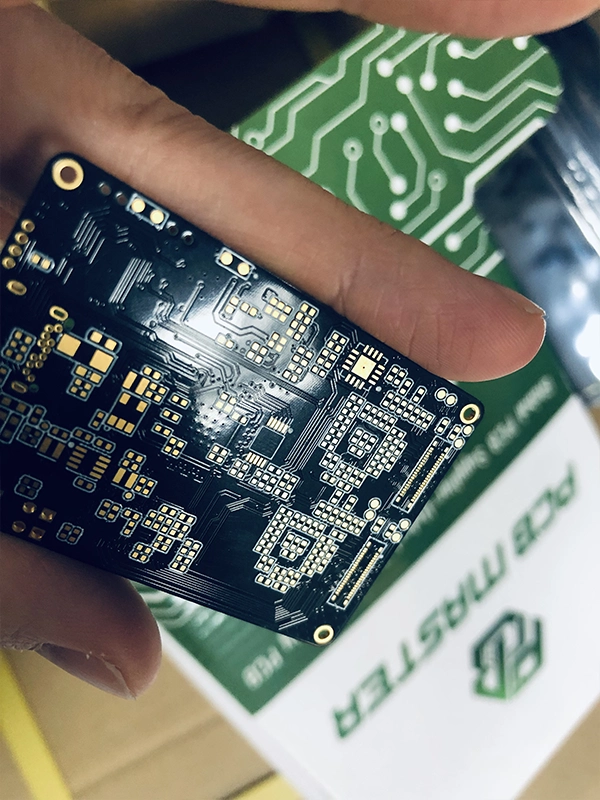
Integrating a PCB Coupon into a panel allows engineers to validate complex design parameters—such as controlled impedance or layer registration—without committing to a full production run. By utilizing this 1.5-inch by 0.5-inch test structure, developers often reduce verification expenditure by up to 85% compared to fabricating standalone test boards. This technique ensures that critical physical properties align with IPC-2141A standards while maximizing panel yield. Companies like PCBMASTER leverage this integration to maintain stringent signal integrity for high-density interconnects without incurring excessive NRE costs.
When engineers design high-speed boards with trace widths reaching down to 3 mil, fabrication houses must ensure that etching processes remain stable across the entire panel. A PCB Coupon provides a sacrificial test site that mimics the primary design's stack-up, allowing for destructive micro-sectioning to verify plating thickness and dielectric spacing. Data shows that 12% of high-layer count boards fail due to via-barrel cracking if these parameters aren't verified during the prototype phase.
Plating thickness variations exceeding 0.5 mil can significantly alter the characteristic impedance of differential pairs, potentially shifting signals by over 10% from their target values. Testing this via a coupon prevents systemic batch failures.
The utility of a PCB Coupon extends beyond mere geometric verification, as it serves as a platform for material characterization under thermal stress. Manufacturers often subject these coupons to three cycles of solder reflow at 260°C to ensure that the laminate-copper bond maintains structural integrity. By validating material performance early, production teams minimize the risk of delamination when handling batches of over 10,000 units.
| Testing Metric | Standard Tolerance | Coupon Verification Method |
| Impedance | ±5% | TDR Measurement |
| Dielectric Thickness | ±10% | Micro-section Analysis |
| Plating Uniformity | >20 µm | Cross-section Inspection |
Establishing a robust testing protocol ensures that fabrication parameters remain consistent during the transition from prototype to full-scale assembly. When production volume increases by 40%, the reliance on a PCB Coupon for real-time process monitoring becomes essential for maintaining yields. Relying on these coupons allows shops to adjust etching chemistry or drilling speeds without interrupting the primary manufacturing line.
Using automated impedance testers on a PCB Coupon allows for rapid validation, cutting measurement time by 60% per panel compared to manual probe methods. This process is critical for boards with more than 8 layers.
Designers who integrate a PCB Coupon effectively reduce the footprint of test structures, reclaiming up to 4% of the panel area that would otherwise be designated as scrap. This space optimization is particularly useful when working with high-cost materials, such as those used in aerospace or medical electronics. Managing this layout efficiency prevents wasted material costs across production runs that reach annual volumes of 50,000 units.
Data gathered from a PCB Coupon provides a documented history of the manufacturing process, which is necessary for meeting ISO 9001 certification requirements. This historical record proves that every batch met the design specifications regarding trace geometry and plating quality. Maintaining this data reduces the necessity for repeated testing on final assemblies, which saves nearly $300 in labor costs per batch of complex boards.
The use of a PCB Coupon for verifying thermal shock resistance ensures that the coefficient of thermal expansion (CTE) matches design expectations, preventing failures in environments where temperatures fluctuate by 80°C.
Engineering teams frequently utilize these coupons to evaluate the efficacy of various soldermask types or surface finishes such as ENIG or HASL. Testing these finishes on a PCB Coupon rather than a populated board prevents the waste of expensive components during the initial evaluation. This approach saves approximately $1,200 per board design iteration when working with high-pin-count BGA packages.
By standardizing the inclusion of a PCB Coupon, organizations achieve a higher level of predictability in their supply chain. When vendors can demonstrate that their process remains stable through constant coupon monitoring, the trust between the design firm and the manufacturer grows. This stability directly impacts the time-to-market, allowing new designs to proceed to mass production 3 weeks earlier on average.