
A scent experience takes longer than a brand expects because it is two projects running at once: a construction and commissioning job, and a perfumery job that cannot be finished until the rooms exist. The stages are predictable even when the durations are not, and the calendar is usually set by three things rather than by the scent itself: custom casework, the integration of air handling with the building, and the commissioning period during which the exhibits are adjusted against real visitors. Brands that plan those three as separate tracks finish closer to schedule than brands that plan an opening date and work backwards.
Key takeaways
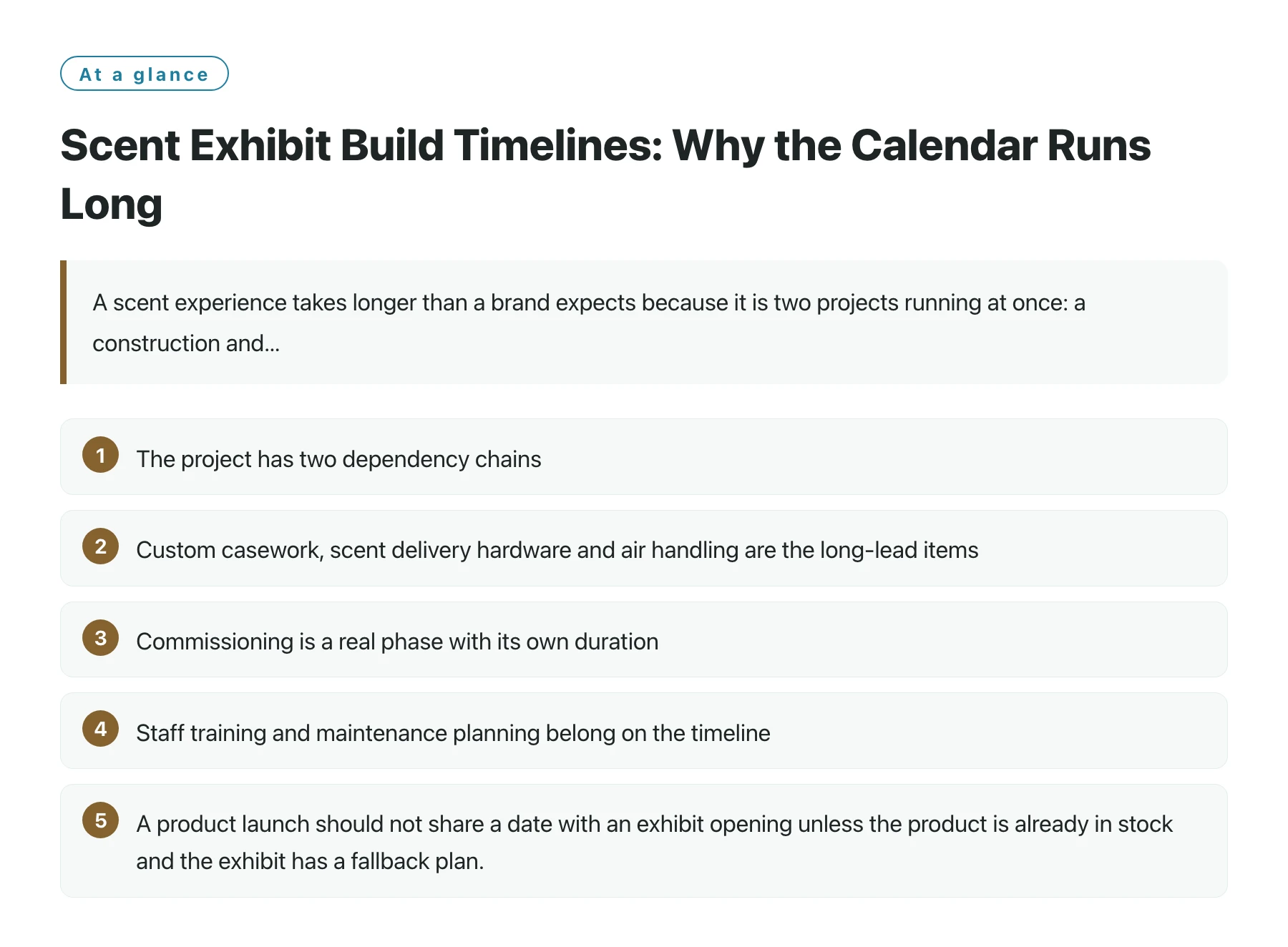
- The project has two dependency chains, one for the space and one for the scents, and they converge at commissioning rather than at design.
- Custom casework, scent delivery hardware and air handling are the long-lead items; the blend itself is rarely the bottleneck.
- Commissioning is a real phase with its own duration, because scent intensities have to be tuned in a room full of people rather than in a laboratory.
- Staff training and maintenance planning belong on the timeline, since an untended scent exhibit degrades within weeks.
- A product launch should not share a date with an exhibit opening unless the product is already in stock and the exhibit has a fallback plan.
Brands commission scent experiences for different reasons: a flagship, a trade show, a museum partnership, a hospitality space. The reasons change the content but not the shape of the project. There is a design phase that produces a narrative, a fabrication phase that produces a room, a scent phase that produces a set of materials and dosages, and a commissioning phase that reconciles the three.
The surprises come from assuming those phases are sequential when they are partly parallel and partly dependent. Getting the order right is what shortens the project, and it is the part a brand can control before any supplier is chosen.
The stage order, and what each stage needs before it can start
- Narrative and routeDecide what the visitor should understand and in what order, because the route determines how many scent stations exist and how far apart they sit.
- Material researchCollect the raw materials, references and cultural context the story depends on, since the exhibit is only as specific as its ingredients.
- Scent design and dosingBuild the compounds and decide intensity, dwell time and rest intervals for each station, which is a design decision as much as a perfumery one.
- Prototyping and nose testingTest the sequence with real people at real walking pace, because a scent that reads well on a blotter can vanish in a busy corridor.
- Fabrication and building integrationProduce casework, stations and delivery hardware, and connect extraction and air movement to the building services.
- CommissioningTune intensities, check migration between zones and confirm the sequence works on a normal visitor day, not only on an empty one.
- Training and maintenanceHand the exhibit to the people who will run it, with a schedule for replenishment, cleaning and periodic review of the scent set.
The three items that actually set the date
Custom casework and display hardware come first, because they are made to order, they are physical, and they cannot be compressed much once the design is frozen. Anything involving a bespoke mould, a specialist finish or a sealed case falls into this category, and a late design change here costs weeks rather than days.
Building integration comes second, and it is the item most often underestimated. Scent delivery has to work with the ventilation that already exists, and extraction, air movement and zoning are building services work rather than exhibit work. If the exhibit is inside a space the brand does not control, the calendar now depends on a landlord, a contractor and a permit, none of which respond to a launch plan.
Commissioning comes third, and it is not a formality. Intensity that reads correctly in an empty gallery can be overpowering at ten visitors per minute, and the correction is not a software setting; it is a dosing decision that has to be tested and re-tested. Museums treat the equivalent phase as part of the project rather than as an afterthought [1], which is why a serious schedule reserves real time for it.
Where a brand's own product timeline interacts with the exhibit
An e-commerce brand usually approaches a scent experience with a second clock running: a product drop, a seasonal range or a retail listing. The temptation is to align the two dates for a single announcement, which converts one project's risk into the other's.
The risk is asymmetric. A product launch can happen without the exhibit, but an exhibit opening with no stock behind it turns a marketing moment into a customer service problem. A safer arrangement is to treat the exhibit as the backdrop and the product as the primary event, with the exhibit either open earlier or announced separately.
There is also a content cost to a rushed build. A scent exhibit that has not been commissioned reads as a room with diffusers, and the visitors who notice are exactly the ones a brand wants to impress. It is worth looking at how previous projects handled the same sequence before committing a date, because project examples show the order of work more clearly than any schedule template does examples of fragrance projects.
One further dependency is easy to leave off the plan: the people who will talk about the scent. If the exhibit is meant to educate or to support a sales conversation, the staff need time with the material before the room opens. Some brands solve this by sending a team through structured training first, so the opening is a demonstration rather than a rehearsal a place to learn perfumery.
Reading a scent exhibit project the way a permanent institution would
Permanent institutions plan for maintenance from the beginning, because an exhibit that cannot be maintained is an exhibit with a known expiry date. Museum practice around new formats tends to ask the same questions: what will this cost to run, who owns the upkeep, and how will its condition be reviewed over time [2]. Those questions are uncomfortable in a launch meeting and extremely useful in month six.
A useful discipline borrowed from that world is to write the exhibit's operating plan as part of the project, not after it. Which scents are replenished, how often the stations are cleaned, who decides when a note has faded past usefulness, and what the replacement plan looks like when a material becomes unavailable. Answering those in advance shortens the project, because the answers change the design while it is still changeable.
That is the reason a permanent scent museum is a different exercise from a temporary installation. Xuelei runs a Guangzhou scent museum, and the format only works there because the operating plan is part of the building rather than an appendix to it. For a brand planning something smaller, the lesson transfers at any scale: decide how it will be run before deciding how it will look.
A simple scheduling rule that prevents most overruns: never let a scent exhibit and a product launch share a hard date unless the stock is already delivered and the exhibit has an agreed fallback. Two dependency chains converging on one calendar square is how both slip.
Sources
- ICOM — International Council of Museums —— The international organisation representing museums; publishes the ICOM museum definition and professional standards for museum practice.
- Museums Association —— A professional body for museums, publishing guidance and research on museum practice and visitor experience.
Frequently asked questions
How long does a scent experience project take?
The shape is months rather than weeks for a permanent installation and weeks rather than days for a temporary one. The exact duration depends on casework, building integration and how much commissioning time is reserved, not on how quickly the scent can be blended.
What is the longest single item in the schedule?
Fabrication of custom display hardware and building services work are usually the long-lead items. Custom moulds, sealed cases and ventilation changes all sit outside the brand's direct control.
Can the scent work be finished before the room is built?
The compounds can be selected and dosed in advance, but the tuning cannot. Intensity depends on the room, the visitor flow and the extraction, so final dosing only happens once the space exists.
Do we need to train staff for a small installation?
Yes. Someone has to notice when a scent has faded, know what to do about it, and be able to explain what the visitor is smelling. That is training, not a manual, and it takes time.
Should a brand open a scent experience before or after a product launch?
Opening the experience first is usually safer. It creates a tested location and content before the product needs attention, and it means a slipped exhibit schedule does not hold up inventory that has already been paid for.